How to Stop AI Agents from Skipping Steps: State Machines and LTL
July 27, 2026 | 19 minutesIn This Post
- Why Does My AI Agent Skip Required Steps?
- What Is Linear Temporal Logic for AI Agents?
- Why Prompt Instructions Alone Don't Enforce Required Steps
- Thinking in Behaviors Instead of Instructions
- What Does LTL Look Like in a Program?
- Agents Already Have States
- LTL vs. State Machines for AI Agents
- How to Make an Agent Wait for Tools with XState
- Running the Machine
- How Do You Test Whether an Agent Followed the Required Steps?
- Safety and Liveness
- Catching Out-of-Order Agent Actions in TypeScript
- Finite Traces and Real Agent Runs
- Recording an Execution Trace
- From Logs to Behavioral Evidence
- When Should You Use LTL with an AI Agent?
- Behavioral Guarantees, Not Better Suggestions
- Frequently Asked Questions
Why Does My AI Agent Skip Required Steps?
Imagine asking an agent to search your documentation before answering a question. The prompt explicitly says to wait for the search result, but the agent starts answering while the tool is still running. Its answer sounds plausible, and the search eventually returns, so a check of the final output might miss what went wrong.
The problem is the order of operations. The agent had access to a tool, but the workflow didn't require that tool to finish before an answer could begin.
Similar failures show up when an agent approves work before checking it, moves on with unresolved tool calls, or keeps retrying without reaching a clear outcome. More detailed prompts can explain what you want, but the application needs to enforce the steps that must happen.
In this post, we'll use TypeScript and XState to build a workflow that requires search to finish before answering. Then we'll use Linear Temporal Logic (LTL) to describe the rules and check the agent's execution trace: the sequence of states and events recorded during a run. You don't need to know temporal logic to follow the example.
- Answers before a tool finishes: Make the transition wait for the tool result, then check that search completed before answering began.
- Skips a required review or approval: Block the later action until its prerequisite is satisfied, then verify that the prerequisite held when the action occurred.
- Leaves tool calls unresolved: Handle completion and failure explicitly, then check that every started call reached an allowed outcome.
- Retries without finishing: Add retry limits and timeout or cancellation paths, then verify that the run reached a recognized terminal state.
A state machine controls which transitions are allowed. LTL specifies properties we want to hold across execution, and a verifier checks the recorded behavior against those properties. Writing a formula alone doesn't prevent a skipped step or make a stalled tool finish; the application must implement those controls.
What Is Linear Temporal Logic for AI Agents?
Linear Temporal Logic (LTL) is a formal language for describing how a system must behave over time. For an AI agent, it can express requirements such as "search must finish before answering," "every tool call must eventually resolve," and "a started task must end in success or failure." Those requirements can then be tested against the agent's execution trace.
Instead of checking only whether an agent's final answer looks correct, we can verify the sequence of states and events that produced it. This is useful when reliable tool use depends on operations happening in a specific order.
Why Prompt Instructions Alone Don't Enforce Required Steps
Imagine that we're building an autonomous code review agent. As part of the agent, we might write a prompt like this:
Review the pull request, run tests if necessary, leave comments, and only approve if everything passes.
On first review, it sounds reasonable. But how do you know what order the agent will complete these tasks in? What happens if the model decides to approve before finishing the review? Or leaves comments after approving?
We can keep adding more instructions, but eventually the prompt will become a wall of text that's difficult for both humans and models to reason about. It also increases token costs and introduces more opportunities to add conflicting instructions over time.
If you look closely at our prompt, though, you'll notice something interesting: we're using natural language to describe a state machine. We're describing an ordering problem (which tasks must happen before others) and natural language is imprecise for that.
That's what formal specification languages were invented for.
Thinking in Behaviors Instead of Instructions
Instead of describing behavior procedurally, temporal logic lets us describe properties that must always hold. For example:
- A pull request must always be reviewed before approval.
- If tests fail, approval must never occur.
- Every requested tool call must eventually be completed.
- An agent that starts a task must eventually either succeed or fail at that task.
These are the rules that define whether the system behaved correctly and they must be followed regardless of which LLM generates the response.
What Does LTL Look Like in a Program?
LTL extends propositional logic with operators about time.
Here are the symbols we'll use in this post:
| Symbol | Meaning |
|---|---|
G φ | φ must always be true |
F φ | φ must eventually become true |
φ → ψ | If φ is true, ψ must be true |
φ ∨ ψ | Either φ or ψ is true |
If that syntax looks intimidating and takes you back to your college math and logic courses, don't worry! The ideas are much simpler than they appear. In fact, you're probably already thinking about these concepts informally.
Here are a few simple LTL formulas and what they mean in plain language.
G(approved → reviewed)
means:
Approval should never happen unless the review has already completed.
Or:
G(toolRequested → F toolCompleted)
means:
Every tool request should eventually finish.
In a program, names like toolRequested and toolCompleted represent facts we can observe about the current state. We might derive them from state machine states, context values, or emitted events:
| Program observation | LTL proposition |
|---|---|
The machine enters searching | toolRequested |
| The search actor returns a result | toolCompleted |
The machine enters answering | answering |
As the program runs, those observations form a trace:
planning → searching → toolCompleted → answering
A verifier evaluates the trace and checks that every occurrence of toolRequested is eventually followed by toolCompleted. That's something many agent frameworks attempt to enforce today with retries and bookkeeping. LTL gives us a declarative way to describe the guarantee itself.
Agents Already Have States
Modern agents aren't simply generating text. They're moving through workflows to complete tasks, review files, etc.:
Receive task → Plan → Call tool → Receive result → Reason → Call another tool → Generate response
Each step in a workflow represents a state transition. A state machine manages those transitions, while temporal logic specifies the properties that must hold across them.
You can express transitions like:
- Planning must happen before execution
- Two tools can/cannot run simultaneously
- The agent can/cannot answer without verification
- Memory updates must occur after success
- A task cannot remain unfinished forever
These are architectural decisions, not suggestions that can be left to chance through prompt engineering. Combining a state machine with temporal logic lets us apply deterministic workflows to our non-deterministic agents.
LTL vs. State Machines for AI Agents
A state machine and an LTL specification answer different questions. The state machine defines which states exist and which transitions are allowed. LTL describes the safety and progress properties that must hold across the full execution trace.
For example, an XState machine can make a direct transition from planning to answering unreachable. An LTL monitor can independently verify that every observed answering state was preceded by a completed search. Used together, the state machine structures the workflow and LTL provides behavioral evidence that the workflow ran correctly.
How do we put this into action? Let's walk through an example setup with TypeScript and XState.
How to Make an Agent Wait for Tools with XState
Consider an agent that must research a question before producing an answer. Its behavioral requirements are simple:
- The agent must plan before calling a tool.
- It must not answer while a tool call is outstanding.
- Every started run must eventually reach a final state.
- A failed tool call must transition to recovery or failure rather than leaving the agent stuck.
In temporal logic, we can describe these properties as:
G(answering → toolCompleted) # Whenever the agent is answering, its tool call must already be complete G(toolRequested → F(toolCompleted ∨ failed)) # Whenever a tool is requested, it must eventually complete or fail. G(started → F(completed ∨ failed)) # Whenever a run starts, it must eventually complete or fail.
With XState, we can encode a lot of this behavior in the state machine.
Asynchronous work such as model requests, database queries, and tool calls can run as invoked actors. XState starts an actor when the machine enters the state that invokes it and stops the actor when the machine leaves that state.
1import { assign, setup } from "xstate"; 2 3const researchAgentMachine = setup({ 4 types: { 5 context: {} as AgentContext, 6 input: {} as AgentInput, 7 }, 8 actors: { 9 createPlan, 10 searchDocs, 11 generateAnswer, 12 }, 13 actions: { 14 storePlan: assign({ 15 plan: ({ event }) => event.output, 16 }), 17 storeSearchResult: assign({ 18 searchResult: ({ event }) => event.output, 19 }), 20 storeAnswer: assign({ 21 answer: ({ event }) => event.output, 22 }), 23 storeError: assign({ 24 error: ({ event }) => event.error, 25 }), 26 }, 27}).createMachine({ 28 id: "researchAgent", 29 initial: "planning", 30 context: ({ input }) => ({ 31 question: input.question, 32 plan: undefined, 33 searchResult: undefined, 34 answer: undefined, 35 error: undefined, 36 }), 37 states: { 38 planning: { 39 invoke: { 40 src: "createPlan", 41 onDone: { 42 target: "searching", 43 actions: "storePlan", 44 }, 45 onError: { 46 target: "failed", 47 actions: "storeError", 48 }, 49 }, 50 }, 51 searching: { 52 invoke: { 53 src: "searchDocs", 54 onDone: { 55 target: "answering", 56 actions: "storeSearchResult", 57 }, 58 onError: { 59 target: "failed", 60 actions: "storeError", 61 }, 62 }, 63 }, 64 answering: { 65 invoke: { 66 src: "generateAnswer", 67 onDone: { 68 target: "completed", 69 actions: "storeAnswer", 70 }, 71 onError: { 72 target: "failed", 73 actions: "storeError", 74 }, 75 }, 76 }, 77 completed: { type: "final" }, 78 failed: { type: "final" }, 79 }, 80});
That way, the order of operations goes from just a suggestion in the prompt to an encoded structure:
planning → searching → answering → completed ↘ failed ↘ failed ↘ failed
There's no transition from planning directly to answering or from searching to completed. The agent can't enter answering until the search actor has completed successfully, which gives us a useful safety property:
G(answering → searchCompleted)
In plain language, the structure of the machine makes the invalid transition unreachable.
Running the Machine
The machine now defines the agent's allowed states and transitions, but it is still only a description. To execute that workflow, we create an actor from the machine, subscribe to its state changes, and start it.
1import { createActor } from "xstate"; 2 3const agent = createActor(researchAgentMachine, { 4 input: { 5 question: "How does temporal logic improve agent reliability?", 6 }, 7}); 8 9agent.subscribe({ 10 next: (snapshot) => { 11 console.log("State:", snapshot.value); 12 console.log("Context:", snapshot.context); 13 }, 14 15 error: (error) => { 16 console.error("Actor crashed:", error); 17 }, 18 19 complete: () => { 20 const snapshot = agent.getSnapshot(); 21 22 if (snapshot.matches("completed")) { 23 console.log("Answer:", snapshot.context.answer); 24 } else { 25 console.error("Agent failed:", snapshot.context.error); 26 } 27 }, 28}); 29 30agent.start();
A successful run might produce this sequence using the actor above:
planning searching answering completed
A tool failure might instead produce this sequence:
planning searching failed
The machine gives us a sequence of states. That sequence then becomes a trace, which is the execution history we'll test against our LTL specification.
How Do You Test Whether an Agent Followed the Required Steps?
Temporal logic evaluates behavior across an entire trace (aka, a sequence of states) not just one state at a time. Traditional validation, by contrast, usually asks whether the system is valid right now. For example:
1const valid = Boolean(
2 snapshot.context.searchResult &&
3 snapshot.context.answer,
4);
That check can tell us whether the current snapshot contains both a search result and an answer, but it can't tell us how the system reached that snapshot and that distinction matters.
Suppose two executions end in exactly the same state:
1{ 2 state: "completed", 3 hasSearchResult: true, 4 hasAnswer: true, 5}
At first glance, both appear valid but their histories may look very different.
A correct execution might be: planning → searching → answering → completed, while an invalid execution might be: planning → answering → searching → completed.
The final snapshot alone hides the violation. Both executions eventually contain a search result and an answer, but only one respected the requirement that evidence must be gathered before the answer was generated. Temporal logic preserves that distinction because it evaluates behavior across the entire trace. LTL cannot determine whether the evidence itself is true, but it can verify that the agent gathered evidence before making a claim based on it.
| Instead of asking | We can ask |
|---|---|
| Is there a search result? | Was the search completed before the agent began answering? |
| Is the task currently finished? | Did every started task eventually reach either success or failure? |
| Is the tool currently idle? | Did every tool request eventually receive a corresponding completion or failure event? |
These are properties of history and progression, not properties of a single state.
This distinction shows up throughout agentic systems: authenticate before accessing sensitive data, retrieve evidence before making a grounded claim, receive approval before performing a destructive action, and finish required tool calls before returning a response. Temporal logic gives us a way to classify and verify requirements like these.
Safety and Liveness
Temporal properties are often divided into two broad categories: safety and liveness.
A safety property says:
Something bad must never happen.
For example:
G(answering → searchCompleted) # The agent must never enter `answering` before search has completed.
A safety violation can be identified as soon as the forbidden behavior occurs. Consider this finite trace: planning → answering. The moment the agent enters answering before search completes, the property has been violated. No later transition can undo that violation, so we do not need to observe the rest of the execution.
A liveness property says:
Something good must eventually happen.
For example:
G(toolStarted → F(toolCompleted ∨ toolFailed)) # Whenever a tool begins, it must eventually complete or fail.
This property is about progress. A trace such as: planning → searching → toolStarted → waiting → waiting → waiting may not contain an explicitly invalid state, but it shows a different kind of failure: the system has stopped making progress.
This is particularly important for agents because it's easy for an agent to remain in individually valid states while still being behaviorally broken. It may retry forever, wait indefinitely for a tool, repeatedly revise its plan, or bounce between two subagents without ever resolving the user's task. With just snapshot validation, we may see nothing wrong. To see loops, we need trace validation.
Once we turn that trace into data, we can test these properties directly.
Catching Out-of-Order Agent Actions in TypeScript
We can represent a temporal requirement as a function over the full sequence. For example, the property:
The agent must not answer before search completes.
can be checked like this:
1type TraceEntry =
2 | { type: "state"; value: string }
3 | {
4 type: "event";
5 value: string;
6 callId?: string;
7 };
8
9function assertSearchBeforeAnswer(
10 trace: readonly TraceEntry[],
11): void {
12 let searchCompleted = false;
13
14 for (const entry of trace) {
15 if (
16 entry.type === "event" &&
17 entry.value === "searchCompleted"
18 ) {
19 searchCompleted = true;
20 }
21
22 if (
23 entry.type === "state" &&
24 entry.value === "answering" &&
25 !searchCompleted
26 ) {
27 throw new Error(
28 "Temporal violation: answering began before search completed.",
29 );
30 }
31 }
32}
Notice that this verifier maintains knowledge of the past. Instead of looking at just the answering state, it asks whether the required event occurred earlier in the trace.
We can write a similar monitor for unresolved tool calls:
1function assertEveryToolCallResolved( 2 trace: readonly TraceEntry[], 3): void { 4 const outstandingCallIds = new Set<string>(); 5 6 for (const entry of trace) { 7 if ( 8 entry.type === "event" && 9 entry.value === "toolStarted" 10 ) { 11 if (!entry.callId) { 12 throw new Error( 13 "Temporal violation: tool started without a call ID.", 14 ); 15 } 16 17 if (outstandingCallIds.has(entry.callId)) { 18 throw new Error( 19 `Temporal violation: duplicate tool call ID ${entry.callId}.`, 20 ); 21 } 22 23 outstandingCallIds.add(entry.callId); 24 } 25 26 if ( 27 entry.type === "event" && 28 ( 29 entry.value === "toolCompleted" || 30 entry.value === "toolFailed" 31 ) 32 ) { 33 if ( 34 !entry.callId || 35 !outstandingCallIds.delete(entry.callId) 36 ) { 37 throw new Error( 38 "Temporal violation: tool resolved without a matching call ID.", 39 ); 40 } 41 } 42 } 43 44 if (outstandingCallIds.size > 0) { 45 throw new Error( 46 `Temporal violation: ${outstandingCallIds.size} tool call(s) never resolved.`, 47 ); 48 } 49}
Again, no single snapshot necessarily exposes the problem. The violation emerges from the relationship between events over time.
Finite Traces and Real Agent Runs
These monitors work neatly for completed traces, but live and interrupted agent runs introduce another question: what should a verifier conclude when the trace simply ends?
Classical LTL is often defined over infinite sequences. Agent runs, however, produce finite traces: they complete, fail, time out, or are cancelled. This means a production verifier has to decide what the end of a trace means.
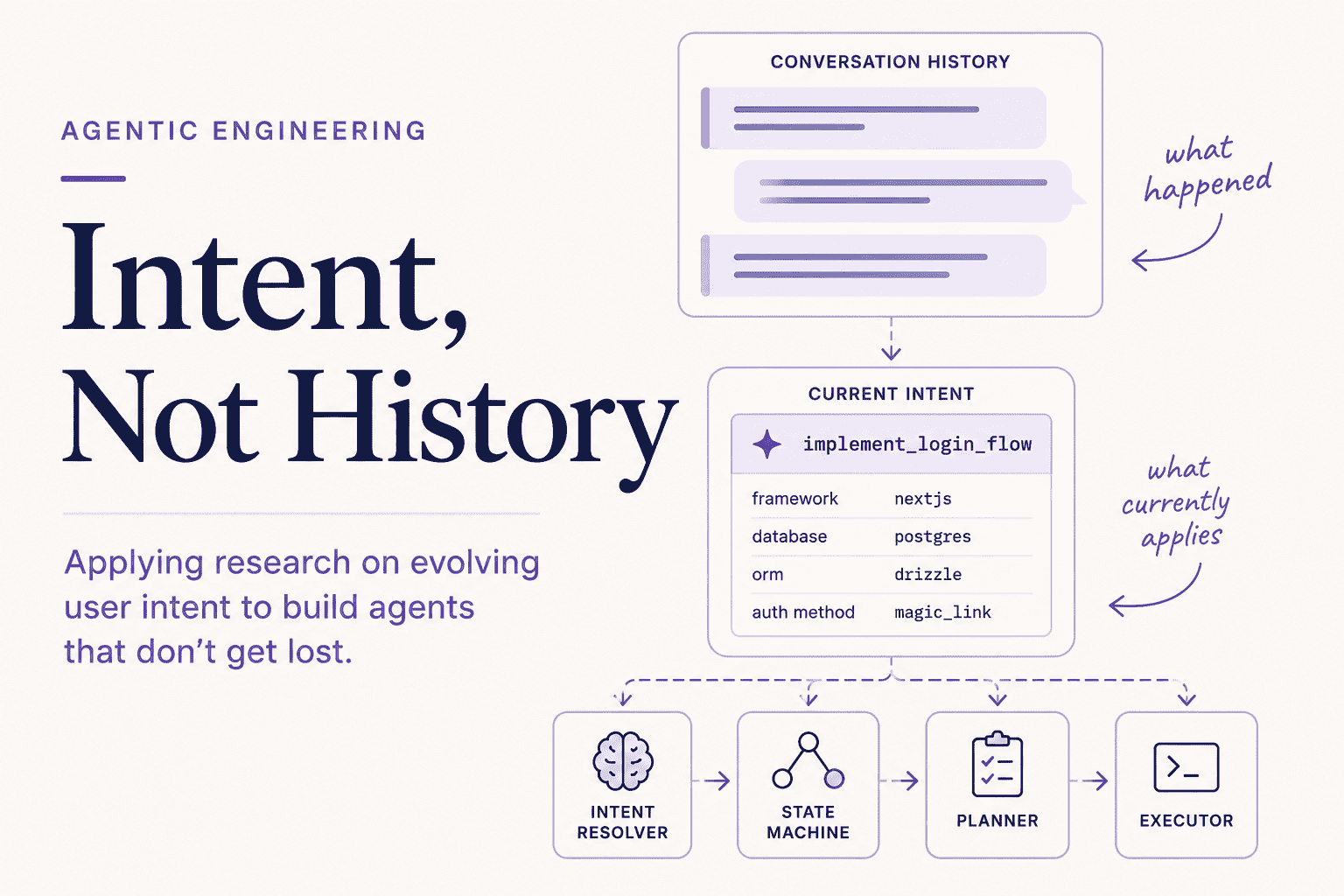
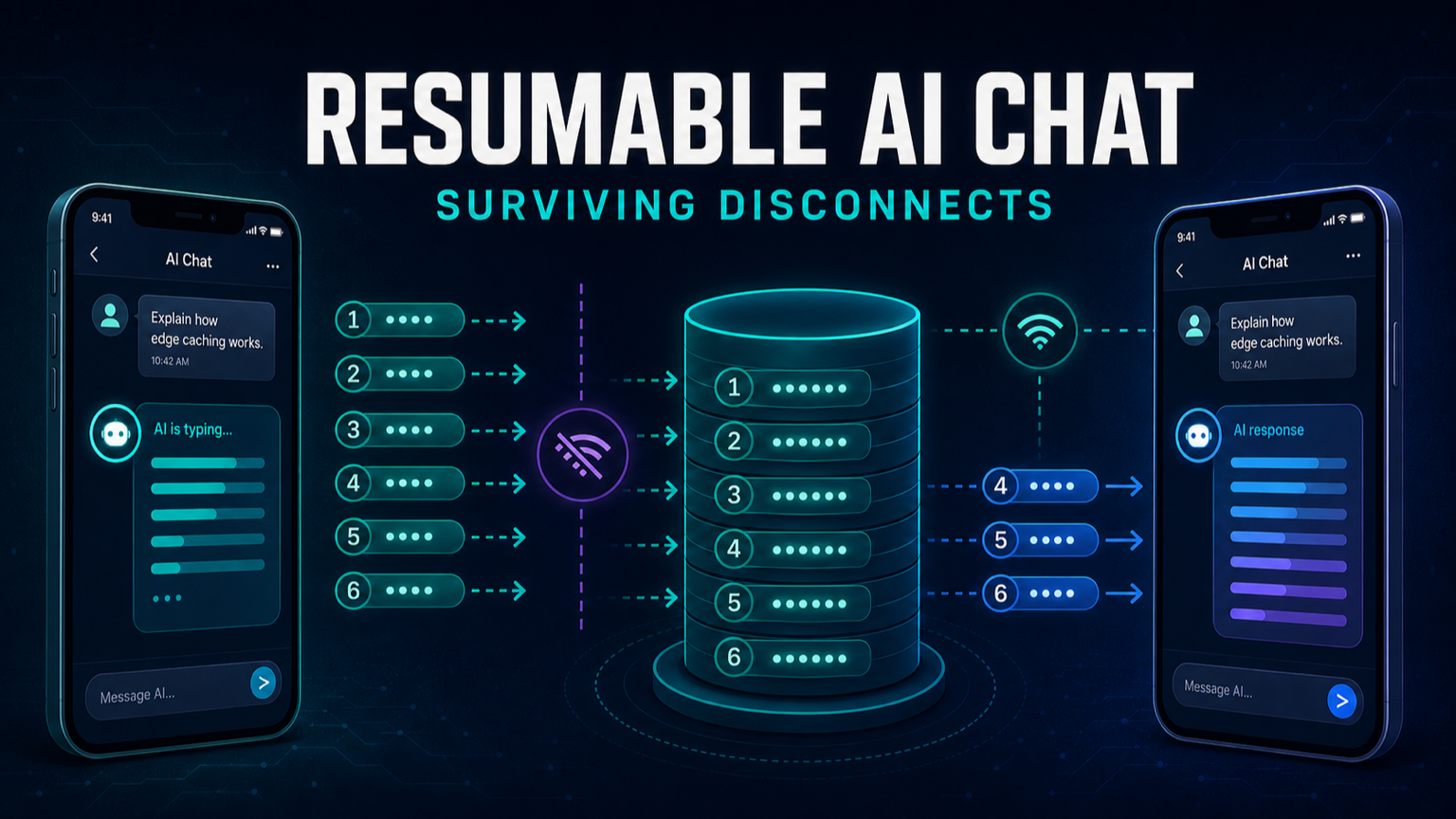
This is the same lifecycle problem that appears when you need to resume an AI chat after a user goes offline or manage evolving user intent over a longer conversation.
Consider this property: toolStarted → eventually toolCompleted. Now consider a trace that ends with: toolStarted → waitingForTool. Has the property been violated?
There are several possible interpretations:
- The tool is still running, so the result is not known yet.
- The workflow was cancelled, so completion is no longer expected.
- The trace ended unexpectedly, so the tool call should be treated as abandoned.
- A timeout occurred, which should count as a failure transition.
The important point is that termination semantics must be explicit. In an XState machine, this usually means modeling outcomes such as:
completed failed cancelled timedOut
rather than treating every stopped trace as equivalent. A temporal specification can then describe the acceptable outcomes:
G(toolStarted → F(toolCompleted ∨ toolFailed ∨ cancelled ∨ timedOut))
This makes the runtime behavior much easier to reason about. Every started operation must eventually reach a recognized resolution state, even if that resolution is not success.
Recording an Execution Trace
With those termination semantics defined, we can record every XState snapshot and turn it into a trace suitable for testing or verification:
1type AgentState = 2 | "planning" 3 | "searching" 4 | "answering" 5 | "completed" 6 | "failed"; 7 8type TraceEntry = { 9 state: AgentState; 10 timestamp: number; 11 hasPlan: boolean; 12 hasSearchResult: boolean; 13 hasAnswer: boolean; 14}; 15 16function runAgent(question: string) { 17 const trace: TraceEntry[] = []; 18 19 const actor = createActor(researchAgentMachine, { 20 input: { question }, 21 }); 22 23 actor.subscribe((snapshot) => { 24 trace.push({ 25 state: snapshot.value as AgentState, 26 timestamp: Date.now(), 27 hasPlan: snapshot.context.plan !== undefined, 28 hasSearchResult: 29 snapshot.context.searchResult !== undefined, 30 hasAnswer: snapshot.context.answer !== undefined, 31 }); 32 }); 33 34 actor.start(); 35 36 return { actor, trace }; 37} 38 39function assertAnsweringRequiresSearch( 40 trace: readonly TraceEntry[], 41): void { 42 for (const entry of trace) { 43 if (entry.state === "answering" && !entry.hasSearchResult) { 44 throw new Error( 45 "Temporal violation: agent entered answering without a completed search result.", 46 ); 47 } 48 } 49}
Once execution is captured this way, the same trace can support local tests, runtime monitors, and production observability.
From Logs to Behavioral Evidence
Most agent platforms already collect traces for debugging and observability. They record model calls, tool invocations, retries, latency, token usage, and errors. Temporal verification changes the role of that data.
A trace is no longer just a debugging artifact that someone inspects after an incident. It becomes evidence that the system followed its behavioral contract. For every execution, we can ask:
1const result = verifyAgentTrace(trace, specifications);
2
3if (!result.valid) {
4 reportViolation({
5 runId,
6 property: result.property,
7 counterexample: result.counterexample,
8 });
9}
A counterexample might be as small as searching → answering or toolStarted → waiting → cancelled. That minimal sequence is often more actionable than a vague evaluation score. It tells us exactly which guarantee failed and which transition exposed the problem.
When Should You Use LTL with an AI Agent?
LTL is most useful when an agent has requirements about ordering, forbidden behavior, or eventual progress. Consider it when:
- A tool or approval must occur before the agent can take a later action.
- Every started operation must eventually complete, fail, time out, or be cancelled.
- A final snapshot cannot prove that the agent followed the required process.
- You need runtime monitors or tests that identify the exact transition where a behavioral guarantee failed.
For a simpler workflow, explicit state transitions and ordinary assertions may be enough. As an agent gains more tools, retries, interruptions, or autonomy, trace-based verification becomes more valuable. A dedicated verification step for agentic chats can complement these temporal checks by validating the result before it reaches the user.
Behavioral Guarantees, Not Better Suggestions
Prompts still matter, but they are not the right place to enforce every requirement about ordering, progress, and termination. State machines give an agent an explicit workflow. Traces make its execution observable. Temporal logic lets us state what must remain true across that execution.
Together, these tools move agent reliability beyond asking whether the final answer looks plausible. They let us verify whether the entire process that produced the answer was valid.
Frequently Asked Questions
What is Linear Temporal Logic for AI agents?
Linear Temporal Logic (LTL) is a formal language for specifying how an AI agent must behave over time. It can express guarantees such as requiring search to finish before an answer begins or requiring every tool call to eventually complete or fail.
How does LTL improve AI agent reliability?
LTL turns behavioral requirements about ordering, safety, and progress into properties that can be tested against an agent's execution trace. This makes violations observable instead of leaving critical behavior to prompt instructions alone.
What is the difference between LTL and a state machine?
A state machine defines the states an agent can enter and the transitions it can take. LTL defines properties that must hold across the resulting sequence of states. They work together: the state machine structures execution, while LTL verifies its behavior over time.
Can LTL be used with finite AI agent traces?
Yes, but the verifier must define what the end of a trace means. Production agents should model outcomes such as completed, failed, cancelled, and timedOut so that unresolved liveness requirements can be evaluated explicitly.